
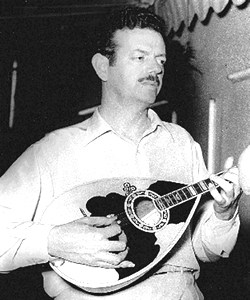
Vassilis Tsitsanis (Βασίλης Τσιτσάνης January 18, 1915 – January 18, 1984) was a Greek singer and songwriter. Vassilis Tsitsanis became one of the leading composers and singers of rebetiko music, which was banned in Greece during its early years, and on the later laika style.
His best-known songs include:
- Synnefiasmeni Kyriaki (Cloudy Sunday)
- Eimaste alania (We are Tramps) lyrics: Eftichia Papagianopoulos
- To Vapori apo tin Persia (The Boat from Persia, about a hashish-laden boat that was captured by the police in Corinth harbor)
- O Sakaflias
- Ta leromena ta aplita (The Dirty Laundry)
Vassilis Tsitsanis may be the most well known Rebetis from the " Classical " era , as well as one of the most prolific and respected composers of the genre. One of the things that set him apart from the other Rebetis who had preceded him, was the fact that he had the benefit of a formal education and had actually been trained as an Attorney. Thankfully he did not allow this fact to inhibit his evolution as a musician and went on to pen some of the most poignant Rebetic compositions ever created , many of which are now recognized as " standards " for the art of " Ta Rebetika".
Biography Vassilis Tsitsanis
Vassilis Tsitsanis was born in Trikala on January 18, 1915. From a young age, Tsitsanis was interested in music and learnt to play the mandolin, violin and the bouzouki which were the mainstay of so many of his songs. In 1936 he left for Athens to study Law, and by 1937, had made his first musical recording.
During the German occupation of Greece, Vassilis Tsitsanis lived in Thessaloniki. There he wrote many of his best songs that were later recorded after the end of the World War II.
In 1946, Vassilis Tsitsanis returned to Athens and began recording many of his own compositions that made famous many of the singers that worked with him, such as Sotiria Bellou (Σωτηρία Μπέλου), Marika Ninou (Μαρίκα Νίνου) and Prodromos Tsaousakis (Πρόδρομος Τσαουσάκης). From then on, Vassilis Tsitsanis enjoyed wide acclaim throughout Greece. Tsitsanis died in London on January 18, 1984; the day he was born sixty-nine years prior. He was mourned across Greece, where his music is still enjoyed to this day and he is regarded as a legend of rebetiko music.
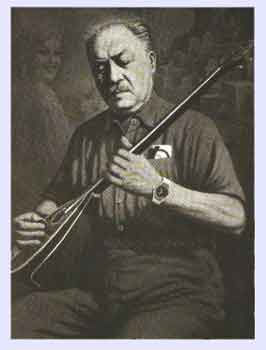 Markos Vamvakaris was born on May 10, 1905 in Ano Chora, Syros, Greece. Markos Vamvakaris family belonged to the sizeable Roman Catholic community of the island, the Frankosyrians, a name deriving from the common Greek reference to West Europeans collectively as "Franks".